Showing posts with label technology. Show all posts

Saturday, August 8, 2009

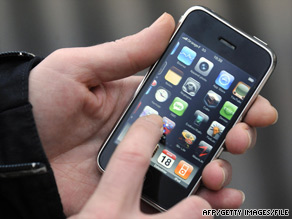
Rejected by Apple, iPhone developers go underground


Apple is the exclusive gatekeeper to its iPhone App Store, able to reject apps at will -- as it did July 28 with Google Voice.
But some developers aren't taking the rejection lying down: They're turning instead to an unauthorized app store called Cydia, where forbidden wares continue to exist -- and even earn developers some money.

That store is operated by Jay Freeman, more fondly known in the iPhone "Jailbreak" community as Saurik. Only five months old, his app store Cydia specializes in selling apps that Apple would reject or ban (or already has).

To use Cydia or the apps available through it, customers need to jailbreak their phones -- hack them to work around Apple-imposed restrictions -- a process that Apple claims is illegal.


Indeed, you can even get a Google Voice app, GV Mobile, through Cydia. After Apple pulled the app from its App Store, developer Sean Kovacs (who is not affiliated with Google) made it available for free through Cydia.

It's difficult to get accurate data on how many customers have jailbroken their iPhones. But based on the number of unique device identifiers tracked on his server, Freeman claims that about 4 million, or 10 percent of the 40 million iPhone and iPod Touch owners to date, have installed Cydia.
On a recent day, he said 470,000 people were connecting to the Cydia store, up from 350,000 per day just a few months ago. Among many free apps, there are also 15 paid apps in Cydia, and the store has earned $220,000 in overall sales in just five months.

"People are so annoyed by Apple and their s---, and if you give them opportunity to go around it, then they'll even pay for it," said Kim Streich, a developer whose app 3G Unrestrictor earned $19,000 in sales in just two weeks through Cydia.

Though Cydia is relatively young, the underground "Jailbreak" community has existed since the first iPhone launched in 2007. That year, Apple didn't yet have an app store for its iPhone, stifling the true potential of the device. This limitation inspired digital rebels to hack away at the iPhone's closed platform in an effort to free its mind.

The result? An app called Installer, opening a door for early iPhone owners to add games, utilities and other third-party software coded by developers.

It wasn't until 2008 that Apple offered a software development kit for third-party coders to make programs for its iPhone. That led to the opening of the official App Store in July 2008. Apple's store grew rapidly, accumulating 65,000 apps and serving over 1.5 billion downloads to date.

Many developers abandoned Installer for the more popular App Store, leaving behind an underground space where unauthorized wares could continue to exist. Installer died and became reborn as Cydia, which evolved from an app library into a store in March 2009.

To gain access to Cydia, iPhone owners must jailbreak their smartphones using some freely available tools courtesy of the hacker group iPhone Dev-Team. Given the nature of this procedure, it's clear Cydia's primary audience consists of nerdy rebels wishing to utilize the full power of their iPhones, restriction-free.

Cydia's numbers appear small compared to the rare stories we hear about developers turning into millionaires with hot sales of their iPhone apps in the App Store. But the idea behind a store like Cydia is that you don't have to be huge to make money.

With a smaller market, fewer competitors and a reasonably large customer base, each developer has a higher chance for making a quick buck, Freeman said. Plus, you get more personal attention: Developers submitting their app through Cydia need only contact Freeman, and their app can be made available almost immediately.

That's an enticing alternative to Apple's approval process, which can take months and is notoriously opaque: Some App Store developers have faced difficulty getting answers to simple questions from Apple about their apps.

It's obvious what's driving iPhone customers toward Cydia: Apple's rejections and restrictions of major iPhone apps. Most notably, Apple recently banned apps supporting Google Voice, the search giant's internet-based phone enhancement service that can provide cellphone users with free text messaging and transcribed voicemail.

Angry consumers and developers theorize that Apple banned the Google Voice apps so as not to detract business from its partner AT&T's phone services. The incident has brewed so much controversy that even the Federal Communications Commission has gotten involved, sending letters to AT&T, Apple and Google inquiring about the reasons for the rejections.

"Looks like Apple and AT&T pissed off a lot of people," Kovacs wrote in a July 28 blog post. "I'll be releasing GV Mobile v1.2 on Cydia for free today or tomorrow."

Another high-profile App Store regulation involves SlingPlayer, an app that enables iPhone users to stream video from a Slingbox device hooked up to a TV. When Sling originally submitted the app, it was capable of streaming over both Wi-Fi and the cellular 3G connection. However, Apple requested Sling to modify the app to work on Wi-Fi only. AT&T said this was a necessary move to prevent congestion on its 3G network.

That restriction spawned the most successful Cydia app to date, 3G Unrestrictor, developed by Streich. 3G Unrestrictor, a $2 app that has sold 9,500 copies, allows the iPhone to circumvent any network limitations imposed by Apple. For example, the app enables SlingPlayer users to stream TV over 3G as well as Wi-Fi; and when using the VOIP app Skype to place phone calls, customers can also use the cellular connection, whereas normally the app only enables users to dial over Wi-Fi.

"It's just amazing what you can do on such a little cellphone, and Apple just forbids customers from doing these things, and it's just a shame," Streich said. "That's why I'm so happy there's a Cydia store."

Another developer who reports positive experiences with Cydia is Jonathan Zdziarski, who said he has made more money through the unauthorized store than Apple's App Store. In February, his app iWipe sold 694 copies in Cydia, compared to 91 copies of iErase in the App Store.

"I guess you could say the App Store is kind of like Wal-Mart, with more crap than you'd ever want to buy," Zdziarski said. "And Cydia is like the general store that has everything you want and need, from fresh cuts of meat to those homemade cookies you can't get anywhere else."

Though some developers say they're having better experiences selling apps through Cydia, it's unlikely they will succeed on a longer term, said Rana Sobhany, vice president of Medialets, an iPhone app analytics company. She said the average consumer would prefer to purchase apps through a well trusted source such as Apple.

"There have been all these apps downloaded in the App Store because it's easy for consumers to find, download and pay for apps," Sobhany said. "This model is new because Apple has been training people how to download music to their iPods for years."

However, even in the case of the App Store, developers who strike it rich still face challenges recreating their success, said Phillip Ryu, co-creator of the e-book reader Classics, which has sold over 400,000 copies to date.

"If you're hoping to reach the mainstream, the best you can hope for is your app catches on fire and charts high enough for you to make a windfall," Ryu said. "Essentially you aim for the jackpot, and if you don't hit that, it's not going to make you a living."

Freeman said it was too soon to tell whether Cydia would provide developers stable incomes, but he recommends they give it a try, considering the successes some are experiencing. He admits, however, he isn't making much money as the creator of Cydia: Like Apple, he takes 30 percent of each app sale to cover taxes.

"I don't make much money off this project, but I value the community, and I look forward to how this changes the device landscape," Freeman said.

source : www.cnn.com

Twitter blackout left users feeling 'jittery,' 'naked'


Christina Cimino was logging onto Twitter on Thursday morning when something happened that she found deeply unsettling.

"I got some weird error message, and I'm like, 'What's going on!?" the 24-year-old said.

That error message was the scourge of online social networkers worldwide on Thursday as cyber-attacks shut down Twitter and caused sustained glitches in other social-media sites like Facebook and the blogging site LiveJournal.

Twitter co-founder Biz Stone wrote the sites were the victims of what "appears to be a single, massively coordinated attack." And a pro-Georgian blogger, whose accounts on Facebook and Twitter reportedly were the targets of the denial-of-service attack, told CNN the online strike was timed to coincide with the one-year anniversary of the Russia-Georgia conflict.

What may prove more lasting about the day social networking suffered its first major blackout is the degree to which people cared. Near-panic erupted in some corners of the Internet as people lost cherished links to their online friends, family members and news feeds.
Part of the panic relates to the sheer popularity of the sites.


Twitter saw a more than 1,300 percent jump in unique visitors between February 2008 and February 2009, according to Nielsen NetView. The site, which lets users post messages of 140 characters or less, had more than 44 million worldwide users in June, according to comScore. More than 120 million users log onto Facebook at least one time each day, the site says.

To be sure, not all Facebook and Twitter users freaked out because of the attacks. Some people even reveled in the mayhem
But for people like Cimino, who said she "felt naked" without access to Twitter, the attacks were a serious reality check -- a chance to evaluate just how dependent they'd become.

"You know how you pat your pockets for your cell phone and your keys? Well it's that same kind of phantom [limb] with Twitter," she said. "It's like, 'I can't update! I can't update!' It's just one of those bugs that gets in you."

She added: "I was pretty upset, actually. It feels like a lifeline for me ... Pretty much everyone knows almost every detail of my life by what I'm doing on Twitter."

It's not worth analyzing whether these online connections are good or bad because the reality is that Twitter and Facebook are now an important part of our lives, said Marc Cooper, a journalism professor at the University of Southern California's Annenberg School for Communication.

"For many people, and not just young people, the Web is not just media, it's actually a place where they conduct their lives or a portion of their lives," he said.

"So the panic [Thursday] morning is only reflective of that. This is not just a hobby or an amusement or another accoutrement, it's actually deeply woven into their lives and is integral to their social interaction. So when it's cut off, it's a problem."

Others saw Twitter's existence as the problem and relished the chance to make fun of a Web site that has become so omnipresent in news cycles.

"Horrors!!! People will have to communicate face to face!" one user commented on CNN's SciTech blog.

Another commenter said, "Turn off your computers and read a book or get outside and discover there is more to life than cyberspace. The Internet has become nothing more than the new cocaine."

Now that Twitter is back online, the No. 1 conversation thread on the site is called "whentwitterwasdown," where users discuss what they did without their real-time Twitter updates.

Some people are mocking the blackout. A user named PaulWilks, for instance, wrote, "I took up juggling."

Others seem concerned. "I did absolutely nothing. It's like my heart was gone," wrote a user named HarajukuxBarbie. "I felt so empty inside," wrote another Twitter user called freinhar.

Some business people on Thursday realized just how much they depend on Facebook and Twitter to do their work.

Adam Ostrow, editor-in-chief at Mashable, a blog that covers social media, said the outage made it difficult for his organization to cover the news and to promote its stories.

"For someone like myself who spends all day on Twitter, it's incredibly frustrating,"
Justin Stauffer, a 31-year-old who works in Web strategy at a marketing company near Philadelphia, Pennsylvania, said Thursday's attack made him realize just how dependent on Twitter he had become.

"When something that's so central to how you do your business or how you gather information goes down, yeah, you get a little jittery -- like, when's it going to be back," he said.

"I didn't break out in hives or anything like that," he said, jokingly.

David Seaman, an iReporter in New York, said he thinks Twitter needs a competitor so users will have an alternative if the site is down.
And Amy Gahran, who writes about social media on a blog called Contentious, said all technologies can break down, so people need to make contingency plans.

"Hell, when you get down to it, you can lose your voice or break your writing hand or have a stroke and be unable to communicate. We are fundamentally social creatures, and when we lack our usual communication channels it's scary,"
"Don't panic. Have a backup plan, and be prepared."

Cooper, the USC professor, said the fuss surrounding Thursday's attack is a sign that instant, online communication is here to stay.

Fighting the trend would be like trying to stop the ocean's tides, he said, but it's unclear where the technology will take our society.

"The bottom line is that we don't know. All of this is too new," he said. "It's like sitting around in the year 1500 and trying to figure out where the printing press was going to take us."

source : www.cnn.com


Friday, August 7, 2009

Twitter hit by denial-of-service attack

Internet attacks shut down the social networking site Twitter for about two hours on Thursday morning and caused glitches in other sites like Facebook and LiveJournal, a blogging site.
It's unclear if the attacks were coordinated against the social media sites.

Twitter says its site's blackout was caused by a "denial of service attack," which likely means a hacker used a herd of infected computers to send bad information to the site to overwhelmed it.

A post to Twitter's blog said its Web site was back online before noon ET, but the site's users still were reporting problems.

"We are continuing to defend against and recover from this attack," the message from the company says.


Facebook and other social networking sites appeared to be affected by Twitter's shut-down, too. Twitter runs applications through those sites and there was speculation that the glitches were related.

"Earlier this morning, we encountered issues within our network that resulted in a short period of degraded site experience for some visitors," said Facebook spokeswoman Kathleen Loughlin.

"No user data was at risk, and the matter is now resolved for the majority of users. We're monitoring the situation to ensure that users continue to have the fast and reliable experience they've come to expect from Facebook," she said.
Twitter's site went down around 9:30 a.m. ET on Thursday and was back online by about 11:30 a.m.

It's unclear who plotted the attack against Twitter and what their motives may have been. Internet attacks sometimes hit Web sites as they become popular. Security experts say financial motives often are behind modern cyber-attacks.
Twitter -- a micro-blogging site where users post 140-character messages to their followers -- has soared in popularity in recent months. According to comScore, a Web tracking firm, the site had 44 million unique visitors in June.

Thursday's incident highlights the degree to which people depend on online social networks to feel connected to the world.

Some Twitter and Facebook users expressed near-panic that the sites were not working properly. Others reacted with ambivalence.

This is not the first time Twitter has been hit with a cyber-attack. Last month, a hacker broke into the personal Google accounts of Twitter employees, stealing personal information and company financial reports and posting them online.

In an e-mail to CNN.com, Twitter co-founder Biz Stone said that incident is not related to Thursday's security breach.

"There's no indication that this attack is related to any previous activities. We are currently the target of a denial of service attack," Stone said in the e-mail.

"Attacks such as this are malicious efforts orchestrated to disrupt and make unavailable services such as online banks, credit card payment gateways, and in this case, Twitter for intended customers or users. We are defending against this attack now and will continue to update our status blog as we defend and later investigate."

Don DeBolt, director of threat research at CA, a computer security company, said it's too early to tell who or what may be behind the Twitter attack.

But he said denial-of-service attacks target specific Web sites.

"To be effective, [these attacks] need to be focused on a Web site or a series of Web sites," he said. "It's not going to be something where malware (harmful software) is going to be deployed and then randomly attacks Web sites."

John Harrison, a researcher with Web security firm Symantec, said it is very difficult to learn the identity of the attacker, or attackers, as they could be anywhere on Earth and the infected network could span several countries.

Logging on to sites such as Twitter while they are under attack only makes the situation worse because it adds to the overloading of the system, he said.
The U.S. Computer Emergency Readiness Team says it's impossible for Web developers to fully prevent such attacks. But everyday computer users can ensure that their machines aren't used in a coordinated attack like the one seen Thursday.

To protect their computers, consumers should update anti-virus software, create passwords that are difficult to crack and maintain computer firewalls, the agency says.

source : www.cnn.com


Saturday, August 1, 2009

City floating on the sea could be just 3 years away

A floating city off the coast of San Francisco may sound like science fiction, but it could be reality in the not-too-distant future.
The Seasteading Institute already has drawn up plans for the construction of a homestead on the Pacific Ocean.

One project engineer described the prototype as similar to a cruise ship, but from a distance the cities might look like oil-drilling platforms.

According to the plans, the floating cities would not only look different from their land-based counterparts, but they might operate differently, too.

Patri Friedman, a former Google engineer who now works for the Seasteading Institute, said floating cities are the perfect places to experiment with new forms of government.

Some of the new political ideas the group is tossing around include legalizing marijuana and making intellectual property communal -- so that everyone would take ownership in art produced on the city at sea.


"The idea isn't just about getting away from rules or getting rid of rules. It's about a system that encourages experimentation with different political systems," he said.
Friedman said the floating city may be built in modular pieces so that city blocks and neighborhoods can be recombined to create new urban layouts.

The idea of building cities on the sea is not new, he said, but the Seasteading Institute has come closer to realizing the goal than others.

"A lot of people over the past hundred plus years have had this idea and even specifically building cities on the ocean to try out new forms of government," he said. "But they've pretty much been totally imagined and if they did try, they totally failed."

There are several unknowns about future attempts to create floating cities, said Christian Cermelli, an engineer and architect with Marine Innovation and Technology, based in San Francisco.

Cermelli, who is part of a team of designers creating a blueprint for the first seastead, said it's unclear if construction is possible -- or what it would cost.

Still, a prototype for the idea may be finished in as little as three years, he said.

Friedman said seasteads are loosely based on oil rigs, but with important modifications.

"We care more about sunlight and open space, so the specifications are different," he said. "Also, oil platforms are fixed in place. We think it's important to have more modular cities. So you would build a city out of buildings that can actually be separated and rearranged."

Cermelli said the ocean cities may use technology from suspension bridges "to expand the space at sea and basically get a roomier platform."

Friedman says the idea of seasteading has met a range of reactions.

"Some people think we're crazy. A lot of people think we're crazy," he said. "Some people think terrible things could happen, others think it would be great."

About 600 people have joined the Seasteading Institute.

Some of them, like Gayle Young, say the idea is exciting partly because it's so different.

"I love the idea because it's audacious. It's big," she said. "It's about pushing frontiers."

Source : www.cnn.com


Friday, July 31, 2009

Androids also used to make iPod Touch competitors


Not only used as a platform and operating system smartphone netbook, Google Android is also used to design a media player. IRiver is one of them to use it to create a gadget that will be the competitor of Apple iPod.

Overview of the similar iPod Touch with the touch screen is 3.5 inches wide. Color is also white, typically before Apple switched to silver. Gadget that K2 is the name given in ,will be equipped with WiFi connection, web browser, Bluetooth, and even digital TV tuner. In addition there are akselerometer position features so that the display screen to adjust the position.

Unfortunately there are no other details about this product. IRiver product manager Danny Bejanoff not sure when this product will be released to the market. If the correct exit, iPod Touch will have a competitor that may be equivalent.

source : www.kompas.com

UK Pentagon hacker loses appeal, will be sent to U.S.

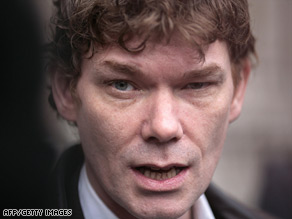
The Briton accused of hacking into U.S. government computers on Friday lost his court appeal to have his case heard in Britain, his legal team said.
The decision means Gary McKinnon faces extradition to the United States, where he is wanted for allegedly hacking into computers at the Pentagon and NASA.

His mother, Janis Sharp, promised to appeal.

McKinnon, who has admitted breaking the law and intentionally gaining unauthorized access to computer systems, wanted to be tried in Britain rather than the United States.

He planned to ask judges at the High Court in London to review a recent decision by the director of public prosecutions not to pursue legal action in Britain, a spokeswoman at the prosecutor's office told CNN July.

The prosecutor's decision effectively cleared the way for McKinnon's extradition.

The U.S. government says McKinnon carried out the biggest military computer hacking of all time, accessing 97 computers from his home in London for a year starting in March 2001 and costing the government about $1 million.

McKinnon, currently free on bail in England, has said he was simply doing research to find out whether the U.S. government was covering up the existence of UFOs.
Prosecutors in the United States and Britain disagree.

"These were not random experiments in computer hacking, but a deliberate effort to breach U.S. defense systems at a critical time which caused well-documented damage," Alison Saunders of the Crown Prosecution Service said in February. "They may have been conducted from Mr. McKinnon's home computer -- and in that sense there is a UK link -- but the target and the damage were trans-Atlantic."

U.S. federal prosecutors accuse McKinnon of breaking into military, NASA and civilian networks and accessing computers at the Pentagon; Fort Benning, Georgia; Fort Meade, Maryland; the Earle Naval Weapons Station in Colts Neck, New Jersey; and the Johnson Space Center in Houston, Texas, among others.

In one case, McKinnon allegedly crashed computers belonging to the Military District of Washington.

McKinnon is believed to have acted alone, with no known connection to any terrorist organization, said Paul McNulty, the former U.S. attorney for the Eastern District of Virginia.

A U.S. federal grand jury indicted McKinnon on seven counts of computer fraud and related activity. If convicted, he would face a maximum of 10 years in prison on each count and a $250,000 fine.

McKinnon's lawyer, Karen Todner, complained that the United States has never provided evidence to prosecutors or McKinnon's legal team to support their extradition request -- and in fact, under Britain's Extradition Act of 2003, U.S. prosecutors are not required to.

McKinnon has previously said it was easy for him to access the secret files.

"I did occasionally leave messages in system administrators' machines saying, 'This is ridiculous,'" McKinnon has said. "(I left) some political diatribes as well, but also a pointer to say, you know, this is ridiculous."

McKinnon was on the brink of extradition in August 2008, when the European Court of Human Rights in Strasbourg, France, refused to reconsider the decision to send him to the United States, effectively clearing the way for his transfer.

Shortly after that decision, however, McKinnon was diagnosed with Asperger syndrome, and he claims that diagnosis changed the case for extradition.

It was on that basis that McKinnon made his appeals in Britain.

Asperger syndrome is a form of autism that affects a person's social communication and interaction, according to Britain's National Autistic Society.

Those affected often are of above-average intelligence and have fewer problems speaking than do those with autism. They sometimes have difficulty knowing when to start or end a conversation and can be very literal in what they say, with difficulty understanding jokes, metaphors and sarcasm.

source : www.cnn.com

Breaking down Microsoft and Yahoo's search deal

With a few strokes of a giant purple pen, Microsoft's Steve Ballmer and Yahoo's Carol Bartz finally signed a deal Wednesday that will turn Microsoft into the second-largest search company in the world, and turn Yahoo into a media-driven advertising broker.
Here's a breakdown of the deal from the perspectives of the key players:

Yahoo

What it gets: Yahoo is paying below market rate for an outsourced search engine: Microsoft will pay Yahoo 88 percent of future search revenue, a better ongoing deal than had been expected, according to IDC.

It gets a guaranteed stream of search revenue for 18 months, and it gets to sell all the search ads on both Yahoo and Microsoft properties. And it gets to save money, one of the highest priorities for Bartz and new Yahoo CFO Tim Morse: the company estimated it will save $200 million in capital expenditures and see an overall benefit of $500 million in operating income.


What it loses: The ability to control its own destiny when it comes to search, still the most profitable sector of online advertising by a large margin. Yahoo's search revenue is now tied to the performance of Bing for 10 years, an eternity in the Internet world, and 88 percent of something is less than 100 percent of something.

What's next: Probably another reorganization, and another wave of departures as talented search engineers weigh their options among Microsoft, Google, Ask.com, and start-ups.
Expect rosier earnings calls where Bartz can point to the cost savings from the deal, and the evolution of a long-term plan for the company that doesn't involve dumping businesses.

Microsoft

What it gets: Far more search market share in one day than it could have hoped to obtain from organic Bing growth -- no matter how much people may like it -- over several years. All of Yahoo's search technology is now available to Microsoft to pick and choose what it might want to use on Bing.

And Microsoft also avoided having to make an upfront payment to take control of Yahoo search, as had been rumored for months leading up to the deal and hinted at by Bartz herself, claiming "boatloads of money" would be needed to pry Yahoo search away from the company.

What it loses: Relationships with advertisers on search ads, although it preserves its display ad sales operation...for now. Otherwise, Microsoft seems to have emerged from this deal pretty clean.

What's next: Heated search competition with Google, which only means the two companies have even more reason to detest each other.

Google

What it gets: Time. This deal will take months, if not years, to complete, and it will be a messy integration process. Google sales representatives likely called up all of their major clients this morning to remind those clients of the uncertainty that will accompany the integration process, and the notion that their ad dollars might be better spent with the more stable operation.

Google also gets to deflect some of the antitrust scrutiny that has been directed its way by pointing out that a combined Yahoo-Microsoft search property has a very healthy share of the market.

What it loses: The ability to play Yahoo and Microsoft search off one another: fractured competition meant it would have been much harder for either company to make serious inroads against Google on their own. It also turns Microsoft into a credible technology threat with Microsoft's right to pick and choose the best of Yahoo's search technology developments and match them with the well-received Bing.

What's next: Business as usual, for now. Google never had any intention of ceding its search lead before this deal was announced, and while there's arguably more pressure now to live up to that promise over the next several years, it's not anything that wasn't expected in Mountain View.

Advertisers

What they get: A credible second option for their ad spending, assuming ad spending ever becomes trendy again amidst the current economic backdrop. They're also in store for a renewed pitch on the benefits of Internet display advertising, which probably still doesn't resonate on Madison Avenue but may one day start to make sense for the Internet advertiser.

What they lose: The relationships between advertisers and the two companies will likely grow very complicated over the next several months as those used to working with certain representatives transfer their business to new faces. Those problems aren't insurmountable, but they can be annoying.

What's next: If the ad market ever comes back, renewed competition in search advertising for keywords, placement, and reach.

Consumers

What they get: "Powered by Bing" search results on Yahoo pages.

What they lose: Usually, consolidation is seen as bad for consumers--take banks as an example -- because it reduces choice.

What's next: The consumer impact of this deal is not obvious, especially not at this point with so many details left to be hammered out. One could argue that if Yahoo wasn't really committed to search, consumers would see better search results over time on Bing-powered Yahoo pages. And there are indirect benefits to consumers that come along with having advertisers that aren't chained to one search engine.

But this is really about freeing up Yahoo to focus more on its other businesses, and giving Microsoft more market share to force Google into playing defense on search, which could alleviate some of the pressure Google is putting on Microsoft with things like Google Apps and Android.

It will take some time for the impact of these decisions to filter down to the consumer: assuming the government gives the deal its blessing.

source : www.cnn.com


Monday, July 27, 2009

Whatever happened to the Conficker worm?

Remember Conficker?
The hugely talked-about computer worm seemed poised to wreak havoc on the world's machines on April Fool's Day.

And then ... nothing much happened.

But while the doom and gloom forecast for the massive botnet -- a remotely controlled network that security experts say infected about 5 million computers -- never came to pass, Conficker is still making some worm hunters nervous.

Phillip Porras, program director at SRI International, a nonprofit research group, said Conficker infects millions of machines around the world. And the malware's author or authors could use that infected network to steal information or make money off of the compromised computer users.

"Conficker does stand out as one of those bots that is very large and has been able to sustain itself on the Web," which is rare, said Porras, who also is a member of the international group tracking Conficker.

Still, computer users, even those infected with Conficker, haven't seen much in the way of terrifying results.

After the botnet relaunched April 1, it gained further access to an army of computers that the program's author or authors could control.

The only thing the author or authors have done with that power, though, is to try to sell fake computer-security software to a relatively small segment of Conficker-stricken computers, Porras said.

The lack of a major attack has led some people in the security community to assume that the worm is basically dead.

Mikko Hypponen, chief research officer with F-Secure, an Internet security company, says the people who created Conficker would have launched a major offensive by now if they were going to.

Hypponen, who is scheduled to speak about the Conficker botnet next week at Black Hat, a major computer security conference, said he thinks whoever made Conficker didn't mean for the worm to get so large, as the size of the botnet drew widespread attention from the security community and the media.

"This gang, they knew their stuff. They used cutting-edge technology that we had never before. ... I've been working in viruses for 20 years, and there were several things that I'd never seen at all," he said. "That, to me, would tell that perhaps this is a new group or a new gang, someone who tried it for the first time."

He added, "The more experienced attackers don't let their viruses or their worms spread this widely. They, on purpose, keep their viruses smaller in size in order to keep them from headlines."

Veteran botnet creators tend to hold the size of the malicious networks to about 2,000 to 10,000 computers to keep from being noticed, he said.

"Even if the [Conficker] gang would want to continue operations, most likely they would drop the current botnet and start something new," he said.

Don DeBolt, director of threat research for CA, an information technology company, said researchers are still watching Conficker.

"It's still being tracked, so it is still active out there, but certainly the threat has been mitigated by all of the attention and focus that it has received," he said.

DeBolt said the press hyped the Conficker story because it was tied to April Fool's Day and because it made so many computers vulnerable to attack.

He said other viruses and botnets pose more serious threats.

Graham Cluley, senior technology consultant at Sophos, a computer security company, said the infected Conficker network is still growing.

"The interesting thing is, the hackers never really did much with the botnet that they created. So they created an army of lots and lots of computers ... but they've never really done anything with it," he said. "They were almost frightened off doing it."

Others disagree with that assessment.

Hypponen said Conficker was not hype; it was the largest network of its kind seen since 2003 and deserved the attention it got from the security community and from the public.

Porras said theories about the the motives of Conficker's creator are based on speculation.

The important thing, he said, is that security experts will continue to work to reduce the number of computers infected with the worm.

source : www.cnn.com


Friday, July 24, 2009

Market slumps for $3,000 luxury cell phones

Got a few grand to spare for a $3,000 phone? Yeah, we didn't think so. Nobody does -- and that's a problem for the makers of luxury phones, such as Motorola, Bang & Olufson, LG and Vertu.
After years of chasing the ultra-wealthy with exclusive devices that carry designer logos and promise craftsmanship from materials such as sapphire and stainless steel, luxury phone makers are now pulling back.

"The culture has shifted away from conspicuous consumption, so if you are going to have a super expensive product this may not be the time for it," says Avi Greengart, research director for consumer devices at Current Analysis.


Motorola has already gotten the memo. Earlier this week, the company reportedly canceled the Ivory E18, a device tentatively priced around $3,000. The phone had met with lack of interest from telecom carriers. Motorola declined to comment.

If that sounds like an obvious outcome, perhaps it shouldn't. In the last few years, luxury phones had turned into an attractive new business, as designer houses rushed to get a foothold in the tech sector.

Prada collaborated with LG to launch two LG Prada phones in Europe and Asia.

Last September, Samsung launched the M75500 Night Effect phone, which carried the Emporio Armani insignia.

A month later, Motorola offered a $2,000 phone, called the Aura, which was fashioned out of stainless steel and sported a 62-carat sapphire crystal lens.
And then there's Vertu, a company that makes true luxury phones, the cheapest of which costs about $6,000.

The recession put a spoke in those plans. And it's not just the 401Ks of middle-class Americans that have been in peril.

In Russia, many newly-minted billionaires saw their fortunes slip away with falling oil prices. By the first quarter this year, the U.S. economy had shrunk 5.5 percent. Even 50 Cent has complained about losing more than a few Benjamins on the stock market.

And just like that, the crystal dominoes started to fall. Last October, Bang & Olufsen, whose phones retailed in Europe for more than $1,500, shuttered its cellphone business as it decided to trim its costs and get out of non-profitable ventures. Motorola is the latest to pull back its luxury line.

Luxury phones have never been a big phenomenon in North America, says Greengart. Their manufacturers have had better luck in emerging markets. But now even in those countries, where once 8 percent GDP growth seemed conservative, wealthy consumers are feeling the pinch.

"Super expensive, bling bling phones are big in markets where conspicuous consumption is a way to tell your countrymen you have arrived," says Greengart. "But now, it's a very different economy for everyone."

Many of the troubles that the uber-expensive phones face are because they are created by companies whose main expertise is in targeting a mass market, says Frank Nuovo, former chief of design for Nokia and current head of Vertu.

"I didn't start this business to soak the phones in diamonds and jewels," says Nuovo. "The concept is same as a fine watch or a fabulous car. To be a true luxury product, you have to look at making something that doesn't have an 18-month shelf life."

True luxury, as Nuovo defines it, doesn't apply to a mere $2,000 phone: A Vertu device, soaked in platinum, can run up to $70,000. The company's one-off phones, designed in collaboration with luxury jewels house Boucheron, cost even more.

Nuovo may have inadvertently hit on the real problem with luxury phones: Phones are still a very feature-driven products. They are products where the rapid advances in technology can rend older models obsolete very quickly.

"Phones aren't like a handbag where the fundamental utility remains the same and the design changes all the time," says Greengart.

But Nuovo isn't convinced. "Take watches and cars," he says. "They all run the same but everyone has a unique way of delivering them stylistically. We can do the same with phones."

Despite the bumps on the road now, Nuovo says the luxury phones will bounce back and find an audience. "It is no different than a fine watch or a car," he says. "If you take people who value something that is made extraordinarily well there will always be a group interested in it."

Vertu is determined to prove that. It will launch its latest handset the Carbon Fibre Ascent Ti in August. The phone is made of high-gloss carbon fiber and has a sandblasted titanium surface. The price tag? $9,800.


Buzz building for 'Batman: Arkham Asylum' game

Imagine taking the best characters and elements of your favorite fictional universe and weaving them into a new story that captures the imagination of fans.
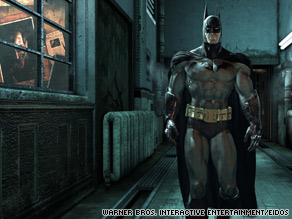
That's what Emmy-winning TV writer Paul Dini did in creating "Batman: Arkham Asylum," a video game coming out in late August. Buzz is building online for the dark, cinematic game, which reimagines a brooding Batman and his most notorious nemesis, the Joker, for an experience that's reminiscent of "The Dark Knight" blockbuster movie.

You want mayhem, insanity and brutality? Get ready for all of it.

"This is the Batman movie I would have liked to have written," said Dini, who was scheduled to discuss the game during a panel Saturday at Comic-Con International, the huge celebration of comic-book culture in San Diego, California. "This is him with all the good stuff."


The atmospheric game pits Batman against Joker in a battle of wits and brawn after the Clown Prince of Crime traps the Caped Crusader inside Arkham Asylum, Gotham's psychiatric hospital for the criminally insane. After the trap is sprung, the Joker releases the inmates, including some of Batman's most ferocious enemies: Bane, Harley Quinn, Mr. Zsasz, Poison Ivy and Killer Croc.

Batman has appeared in video games since 1986, but none as ambitious or complex as "Arkham Asylum," which draws much of its inspiration from the character's comic mythology.

The game will be released for the Xbox 360, PlayStation 3, and Microsoft Windows. It's being developed by Rocksteady Studios and will be published by Eidos Interactive in conjunction with Warner Bros. Interactive Entertainment and DC Comics. (Warner Brothers Interactive Entertainment is a division of Time Warner, which owns CNN.)
As the lead writer for the game, Dini said he was given a clean slate to work from. Because there was no movie, graphic novel or comic tie-in to follow, he was able to create an original story.

Dini's familiarity with the main character may help win the hearts and wallets of gamers. Winner of five Emmy awards, Dini has worked on Batman comic books and written episodes of "Batman: The Animated Series" and later, "Batman Beyond."

Dini, who has also written for the ABC-TV hit "Lost," said he was influenced by Batman lore from character creator Bob Kane, the Batman comics of the 1960s and the Dark Knight graphic novels of Frank Miller. In creating his story's look and tone, Dini said he chose his favorite elements from different incarnations of Batman.

For example, the game emphasizes Batman's intellect and use of technology by solving puzzles with the help of such tools as X-ray scanning and a pheromone tracker.

"Detective work is a crucial game element," Dini said. "There are a lot of forensics aspects to the story."

If you're expecting a Heath Ledger-like Joker in "Batman: Arkham Asylum," you may be disappointed. With his less-smudgy makeup, spiky green hair and maniacal cackle, Dini's creation looks and acts more like earlier versions of the iconic villain.

Kevin Conroy voices Batman in the game, while the Joker is voiced by Mark Hamill, known to millions as Luke Skywalker in the "Star Wars" movies. Conroy and Hamill were scheduled to join Dini at Comic-Con this weekend.

Both actors also did the voices in "Batman: The Animated Series," making the game feel very familiar.

Sterling McGarvey, a senior editor for G4TV, said the game's developers were smart to rely heavily on the animated TV series.

"An entire generation of Batman fans grew up with the animated Batman," he said. "It is a beloved, storied franchise with very few good games." The Internet is full of videos showing glimpses of the game, including movie-like trailers, demo gameplay, characters and layouts of Arkham Asylum. Among Batman fans and gaming reviewers, early reviews have been strong.

Brian Crecente, editor-in-chief of Kotaku.com, said he likes the way the developers combined elements to create the ultimate Batman from the fans' perspective.

"Part dark, broody Batman, part serious crime fighter, but also part detective," Crecente said. "Batman has this huge universe. Why not cherry-pick the best stuff and put it in the game?"

A key character in the game is Arkham Asylum itself, with its spooky corridors and Gothic architecture. Dini loves its "mix of dark, creepy, steam punk and Victorian" and calls it the perfect location in Gotham City for the gameplay.

"It is a totally over the top mansion with gargoyles on the inside," added Crecente. "Very cool."

Dini heaped praise on how the developers made his story come to life. He hopes fans who know Batman will love how familiar it feels, while gamers will love the action.

"Fans of the canon will be happy," McGarvey agreed. "But the game was designed more for the Batman fan than a hardcore gamer."

Crecente describes the game's combat as fluid and quick, with a martial arts feel. Acting as Batman, players will be able to hide in the shadows and stealthily take out their enemies.

All the gaming mechanics in the world won't save Batman unless fans get drawn into the story. Remember Lego Batman? But Dini seems confident that gamers will respond to his vision.

"Nobody loves a good Batman story more than I do," he said.

source :www.cnn.com


Thursday, July 23, 2009

Taming Bomb with Robot

With the terror bombing in Jakarta going back to swallow the soul of the victim. During this "taming" bombing in Indonesia, many rely on human expertise. However, in some cases, the threat can be broken by using bomb detectors and bomb equipment tamer.

Later, the risk for fatal robot developed to address them. The use of robots by troops tamer explosives or Gegana police team has done since long time. Unfortunately, robots-robots that are still foreign products, among others, came from England.

The last ten years several research institutions began to develop a national system detectors and bomb robot tamer. Batan National Nuclear Energy (Batan) over the last 10 years developing the system analyzes the explosive material with the drug use fast neutrons neutrons generator.


Neutrons generator technology developed at the Center for Accelerator and Material Process Batan since 1998. Detection is done with the explosive materials emit neutrons files that have been activated to an object, for example, a container which contains the explosive material.

Spectrum of gamma rays caused, can know the content of the container. Because the materials consisting of elements H, C, N, and O in a particular composition, the diffraction spectrum elements are legible.

Handling bomb or explosive materials were also done using the robot. One of them developed by Endra Pitowarno from Politeknik Elektronika Negeri Surabaya Institute of Technology, 10 November, which have produced three generations of robots tamer bomb since 2003.
Meanwhile, Estiko Rijanto, researchers mekatronika and control systems from LIPI, in 2006 successfully designing and building design tamer car bomb robot called Morolipi. Prototype that has the patented design was initially created in 2004.

After Morolipi version 1 (V.1) or the 2006 version Estiko, who has become Head of the Research Center Mekatronika Power and Electricity Mekatronik LIPI, this year's design Morolipi version two (V.2).

"This second-generation prototype will be displayed on the HUT LIPI on 23 August," said Estiko, who completed the program doktornya at Tokyo University for Agriculture and Technology.

Morolipi V.1 designed to help troops Gegana tamer or explosive materials. Robot is 1 meter wide, 90 cm high, and weight 100 kg. Excess car robot is capable of running in the area even with the speed of 1 meter per second without the use of energy because the electric clutch. Robots that run with a chain wheel can also climb stairs.

Morolipi V.1 have arms as long as 70 cm. Beruas two arms can rotate 360 degrees and can bend. At the end of the arm to install the tool and cutter cable clamp.

Morolipi V.1 equipped with artikulator, camera, and infrared sensors that can transmit the image of the results, so telemetry senses the picture can be displayed on the computer screen which operated the service. With the facilities that were installed, the operator can control the maximum distance Morolipi of 6 km with the control stick (joystick).
In the pilot tame explosive materials, Morolipi proven to work effectively, the cut cable chain measuring 2 mm diameter which can trigger an explosion so that the explosives off.

Was stopped after two years, 2007-2008, Estiko and his team began to make the car the second generation of robots, namely Morolipi V.2.

In the version of this robot Morolipi improved ability to carry the firearm. This new generation of robots can be controlled to approach the target and shoot. In addition, the development will also be made to the nonmiliter, that is complete with a robot purifier tank of fuel oil in the harbor.

"This second generation Morolipi akan experienced improvements in the system of allowing rodanya mulus and running more quickly," Estiko dust.

At the next stage, Morolipi the detection system will be equipped with explosive materials. This is done by designing the system and mekatronika sensors. With the development of this series, can be Morolipi vanguard stage combat, robot spotter. Meanwhile, to maintain order Morolipi forces can help overcome antihuru burly riot.

According to him, to reach that stage, take a few more years so that the prototype Morolipi can difabrikasi by industry and used by various parties, including police and military as well as manufacturing and oil and gas.

Development of robot tamer car bomb or a robot, either by Endra and Estiko, can reduce dependence on foreign parties. Making a robot in the country can also cost up to half compared to the import car bomb robot tamer. Import price of robots can reach about Rp 1 billion per unit.

source : www.kompas.com


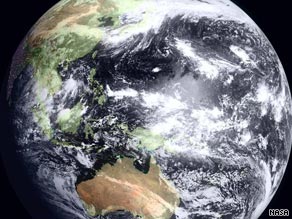
NASA Earth pictures show extent of eclipse

NASA has released new pictures of the Earth showing the vast extent of Wednesday's spectacular solar eclipse.
The longest solar eclipse of the century cast a wide shadow for several minutes over Asia and the Pacific Ocean, luring millions outside to watch the spectacle.

Day turned into night, temperatures turned cooler in cities and villages teemed with amateur stargazers.

The total eclipse started in India on Wednesday morning and moved eastward across Nepal, Bangladesh, Bhutan, Vietnam, China and parts of the Pacific.
NASA said the two images, left, were taken from a Japanese satellite.

The first showed the Earth at 8.30 a.m. local time in Taiwan and the second, an hour later, when the moon completely overlapped the sun (called totality) casting a huge shadow over the area.
advertisement

The longest period of totality occurred over the Pacific, where the total eclipse lasted more than six minutes, NASA said.
Total eclipses occur about twice a year as the moon passes between the Earth and the sun on the same plane as Earth's orbit.

source : www.cnn.com


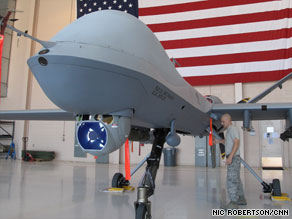
How robot drones revolutionized the face of warfare

Barely an hour's drive from the casinos of Las Vegas, a group of unassuming buildings have become as important as the trenches were to WWI. The big difference? Today's warriors are fighting without getting in harm's way, using drones to attack targets in Afghanistan and Pakistan.
USAF fighter pilot Major Morgan Andrews is one such combatant. He kisses his wife goodbye, drives to Creech, a tiny desert air force base in Nevada, and within minutes could be killing insurgents on the other side of the world.

Andrews fights not from the seat of the F16 he joined the air force to fly but from a darkened ground control station. He pilots a remote-controlled Predator, a UAV (unmanned aerial vehicle) which can spy on and attack positions and personnel without risk to its controller, shooting deadly Hellfire missiles at enemy fighters in support of fellow soldiers.


"You're talking to them on the radios as if we were in a normal airplane flying overhead," says Andrews. "You see the imagery, you know what's going on, you see what you're looking at. It's very easy when something like that is happening to project yourself there and feel a part of the battle. Like I said, your heart starts racing a little bit."
Meanwhile intelligence analysts get to see images in real time and can identify personnel on the ground.

There are now more than 7,000 UAVs ranging from the workhorse, the Predator, and its beefier, deadlier kin the Reaper, to army drones like the tiny hand-launched Raven and the larger Shadow.

The drones are dramatically tilting the war in favor of the United States. Predators, for example, played a key role in killing al Qaeda in Iraq leader Abu Musab al Zarqawi in 2006. UAVs are credited with killing more than half al-Qaeda's top 20 leaders.
Now U.S. Secretary of Defense Robert Gates wants more UAVs. Already he has said that the next generation of fighter planes -- the F-35 that took decades to develop at a cost of more than half-a-billion dollars each -- will be the last manned fighter aircraft.

Lt. Gen. David Deptula, USAF, explains that the next phase will enable a single drone to provide as many as 60 simultaneous live video feeds direct to combat troops. Some new drones will be as small as flies, others walk -- all appear destined to work with decreasing human input.

"The future of how you use these un-manned systems or remotely piloted systems is really unlimited," says Deptula, based at the Pentagon and racing to keep pace with battlefield needs as well as Gates's demands. "We need to open our minds and think more about capability and impact we are going to achieve as opposed to how we've done business in the past."
At Creech frontline requests surged when weapons were first put on the Predator. In Iraq and Afghanistan drones have become so indispensable that missions are cancelled if they are not available

Robotic warfare expert Peter Singer, who advised President Barack Obama's campaign team and has authored "Wired for War," says that remote warfare is changing mankind's monopoly on how conflict is fought for the first time in 5,000 years. All that limits its advance is its application, not the technology.

"The barriers of war in our society are already lowering," he says. "This tech may allow them to lower to the ground. And we might already be seeing this in the strikes being carried out on Pakistan." He points out that raw numbers over the last year show the same number of strikes as the opening of the Kosovo war. "But we didn't debate about it in Congress, we don't talk about it daily in our media."

Pakistani officials say drones are killing al Qaeda leaders who thought they were beyond US reach. But even the U.S. government admits civilians are dying in those attacks too.

Singer fears the use of drones is misunderstood as cowardice, undermining the effectiveness of attacks and ultimately losing the war UAVs are fighting.

He explains that last year one of the most popular songs in the Pakistani charts talked about America fighting without honor, adding that the U.S. is "getting better and better at targeting leaders but perhaps creating a context that gets more recruits."

The spokesman for Taliban leader Mullah Omar recently told me that it is not afraid of drones, that it doesn't fear death. Deptula disagrees and quotes recently declassified comments between two Taliban leaders: "Tanks and armor are not a big deal, the planes are the killers."

He says that of more than 600 Hellfires fired by Predators, over 95 percent exactly hit their targets. Those that failed did so generally through mechanical fault, loss of guidance or a target moving at the last instant, Deptula says.

Singer cites other instances when a computer fault has turned robotic warfare into a mass casualty event. "Last year in South Africa an anti-aircraft had a 'software glitch' during a training exercise," he says. "It was supposed to fire upwards into the sky, instead it lowered and it fired in a circle and killed nine soldiers, all because of a software glitch."
For the U.S. military the gains more obviously outweigh the glitches. Hundreds, possibly thousands, of service men and women have had limbs and lives saved by bomb-detecting bots. Conservative estimates say that fighting from home and putting robots in to war has saved hundreds of millions of dollars.

At Creech the demand for Predator pilots is so intense that it is mobilizing Air National Guard and reservists. It has also introduced an experimental training program for air force cadets from the videogame generation.

Colonel Chris Chambliss, based at Creech, explains: "If you look at younger people right now, they multitask much better than I do. They can do a lot of things with a lot of different information, gather all that in. That's certainly a skill set we need."

Cadet Greg Groves, who is in the Reserve Officers' Training Corps, has never flown a plane before -- but is well aware of his responsibilities. He says: "It's pretty clear that it's not a video game, and it is real life and that what I do directly affects someone else halfway around the world. So I don't think that's going to be a big problem for me."

Groves' father and grandfather were both in the military: when he leaves for Creech he'll be the first in his family to go to war without fear of dying.

Some commanders, such as Colonel Baxter Swift, based at USAF Balad in Iraq, says the future has only just begun. He says: "It's almost like what the hot air balloon was back in the Civil War for us. 'Hey, I can rise above and look around and see what the forces are doing on the battlefield.' So now we are just in the pioneering stage."

Yet if U.S. forces can have UAVs, so can other nations. An estimated 40 or more countries also developing drones, with an Iranian UAV already shot down over Iraq a few months ago. Even Hezbollah -- a political movement, not a state --- has used them against Israel.
For his part, Singer draws another historical parallel, comparing the U.S and the UAV to the British invention of the tank in the early 20th century.

"There is no such thing as a permanent first maneuver advantage," Singer says. "The British came out of WWI with the most tanks, they invented the tank and yet they didn't figure out the best way to use it in the wars they would be fighting. It was the Germans that figured that out and it was the Germans that would be fighting and would win with the tank when WWII starts."

source : www.cnn.com


Wednesday, July 22, 2009

Intel introducing 34nm SSD 80GB/160GB

Several months ago to hear the news that Intel is being set up in the new SSD (solid state disk) with sub-40nm technologies. Today Intel also preach that the product is already present. shapes are the two SSD with 34nm process technology.

Same as previous versions, this new drive berabel X25-M. However, this new silver colored, not black like it. Perhaps this is also the reason why Intel said that they do not expect large differences from the benchmark-based applications.


According to Intel, NAND MLC-based SSD is 25% lower in latency for quick access when compared to X25-M 50nm. This new 80GB model delivers IOPS write 4KB of 6600, while the 160GB version presents a number 8600 IOPS. Duo new plume reaches the rate sekuensial read 250mb / s, with maximum sustained write rate 70MB / s.
If the speed increase is considered less impressive, the price certainly interesting for consumers. His implementation of the 34nm process lithografi cheaper cost, as well as costs in the die NAND chip which is the smaller. Currently, the price of X-25M 80GB version of the channel's U.S. $ 225 and 160GB versions valued U.S. $ 440 (both per unit in 1000). Both have been declining far than a year ago: U.S. $ 595 for the 80GB and U.S. $ 945 for 160GB).

SSD is 34nm Intel has begun marketed in the standard form factor 2.5 "(X25-M Mainstream SATA SSD). Meanwhile, version 1.8 "(X18-M Mainstream SATA SSD) will be introduced at the end of this quarter. both this drive with the same specification. Is just a different physical size.
source : www.kompas.com


Tuesday, July 21, 2009

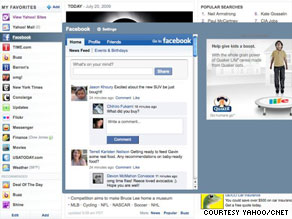
A significant redesign is finally coming to the Yahoo.com home page, one of the most well-traveled destinations on the Internet, and the company's search page will follow suit starting next month.
Yahoo plans to let people in the United States start selecting a new, more personalized version of the home page beginning Tuesday afternoon.

The revamp lets people select basic applications to use not just Yahoo sites, but also others' such as eBay, Facebook, and Twitter, said Tapan Bhat, Yahoo's senior vice president for consumer experiences.


These applications are available on the left side of the page under a customizable section called My Favorites; hovering over them with the mouse pointer makes each application and its accompanying advertising pop up.

"We're pulling together everything about the user they care about, be it on Yahoo or off, to create a personally relevant experience," Bhat said. "In a world like this, Yahoo needs to make the user experience come first."

The effort is a centerpiece of Yahoo's effort to revitalize its core business: showing content and accompanying advertisements to a large, general audience on the Net. Yahoo's profitability for years has trailed that of its main rival, Google, which depends chiefly on search ads for revenue, and Yahoo faces increasing pressure from Microsoft's online business and new arrivals such as Facebook as well.

The company also hopes for more success with advertisers. "We're creating great opportunities for advertisers to target content and context," he said, demonstrating a movie application that showed a prominent ad along with movie showtimes locally tailored for a particular user.
The My Favorites feature will arrive on Yahoo's search page, too, making the search site and results shown on it into more of a portal to access content. Yahoo faces search pressure from dominant Google and now to a certain extent from Microsoft's Bing, too.

Even if it consummates a possible search and advertising deal with Microsoft, being able to show its own display ads in applications adjacent to search results could help the company extract more money from its search operation.

Long-coming changes

Newer Web sites change rapidly, but Yahoo proceeds at a relatively glacial pace to change its site, visited by a whopping 340 million people monthly.

Yahoo announced the new front page plan in October 2007, recognizing that people wanted to get to other destinations on the Net besides Yahoo's. It began "bucket testing" it a year afterward, trying variations of the new page on randomly selected users, some of whom squawked at the changes and their inability to revert.

New Chief Executive Carol Bartz has been trying to light a fire under the company's developers, but even this revamp is only is the beginning beta testing on Tuesday.

The change will arrive in the U.K., France, and India later this week, in Spain and Mexico next month, and in Asia next year, Yahoo said.

Users had no choice about earlier tests, but now they'll be able to select it as default on their own by visiting http://yahoo.com/try new or clicking on Yahoo promotions for the change.

"The home page was tested by thousands and thousands of people. We got tons of feedback -- tens of thousands wrote about what they liked and didn't," Bhat said. "It was really key to helping us figure out what worked and didn't."

The new home page will become default for others when beta testing is done "in the coming months," Yahoo said. The revamped search pages will enter bucket testing in August, meaning that users can't choose to use or not use the new design.

More changes

Opening up Yahoo's content to other sites' operations -- and letting other sites use Yahoo data can use such as Facebook-like status updates -- is part of the Yahoo Open Strategy.

That effort, under way for well over a year, is designed to increase users' activity on Yahoo, to draw more people to Yahoo, and to make the company a better partner for advertisers.

There are about 60 applications available now, and more are being added daily, Bhat said. Users can create their own, too.

Also coming in August will be the ability to select what type of news people can see, with a slider that moves on a spectrum between "fun" and "serious," he said.

In addition, Yahoo is revamping its mobile site. One big feature: when users customize Yahoo for use with regular computers, that customization will carry over to their mobile version.

Bhat wouldn't share details about whether the new home page fares better, either in terms of user engagement or revenue. However, because Yahoo plans to make its official home page announcement Tuesday while detailing second-quarter financial results, it's possible Bartz may be more forthcoming than Bhat.

Bhat did indicate, though, that things are moving in the right direction for the company.

"Our experience in our test indicates that people are excited about this home page. They feel this meets their needs and is fresh new look for Yahoo," Bhat said. "We are designing the page around users. What we do know when design page that users like, they tend to get more engaged."

source : www.cnn.com


Mystery impact leaves earth-size mark on Jupiter

Jupiter is sporting a new scar after a mystery object hit the gaseous planet this week, NASA scientists say.
An amateur astronomer in Australia noticed the new mark on the planet Sunday and tipped off scientists at NASA's Jet Propulsion Laboratory (JPL) in Pasadena, California, who then confirmed it was the result of a new impact, NASA said.

It's not clear what the object was that crashed into Jupiter's poisonous atmosphere.

Glenn Orton, a JPL scientist, told the magazine New Scientist that it could have been a block of ice from somewhere in Jupiter's neighborhood, or a wandering comet that was too faint for astronomers to have detected before impact.

"We were extremely lucky to be seeing Jupiter at exactly the right time, the right hour, the right side of Jupiter to witness the event. We couldn't have planned it better," Orton said in a NASA interview.

Scientists also don't know how large the object was, but the impact scar it created is about the same size as Earth, JPL astronomer Leigh Fletcher told the magazine.

It is only the second time scientists have been able to observe such an impact on Jupiter. The first happened 15 years ago, when comet Shoemaker-Levy 9 broke into 21 pieces and hit the planet's atmosphere.

"Given the rarity of these events, it's extremely exciting to be involved in these observations," Fletcher said in a NASA interview.
Thermal images taken by NASA also showed a bright spot where the impact took place, which meant the crash warmed the lower atmosphere in that area, New Scientist said.

Researchers also found hints of higher-than-normal amounts of ammonia in the upper atmosphere. The Shoemaker-Levy comet also churned up extra ammonia, the magazine said.

Jupiter is the fifth planet from the sun and the largest in our solar system.

Its colorful atmosphere is 86 percent hydrogen and 14 percent helium, with tiny amounts of methane, ammonia, phosphine, water, acetylene, ethane, germanium, and carbon monoxide. The chemicals are responsible for producing the different colors of Jupiter's clouds.

The temperature at the top of those clouds is about -145 degrees Celsius (-230 degrees Fahrenheit), but far hotter near the planet's center. There, the core temperature may be about 24,000 degrees Celsius (43,000 degrees Fahrenheit), hotter than the surface of the sun.

The most outstanding feature on Jupiter's surface is the Great Red Spot, a storm of gas that swirls at a speed of about 360 kilometers (225 miles) per hour at its edge. The diameter of the spot is about three times that of Earth.

source : www.cnn.com


Monday, July 20, 2009

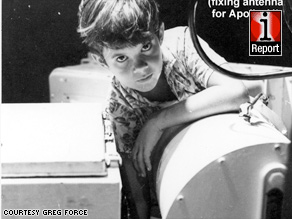
The 10-year-old who helped Apollo 11, 40 years later


On July 23, 1969, as Apollo 11 hurtled back towards Earth, there was a problem -- a problem only a kid could solve.
It sounds like something out of a movie, but that's what it came down to as Apollo 11 sped back towards Earth after landing on the moon in 1969.

It was around 10:00 at night on July 23, and 10-year-old Greg Force was at home with his mom and three brothers. His father, Charles Force, was at work. Charles Force was the director of the NASA tracking station in Guam, where the family was living.

The Guam tracking station was to play a critical role in the return of Apollo 11 to Earth. A powerful antenna there connected NASA communications with Apollo 11, and the antenna was the only way for NASA to make its last communications with the astronauts before splashdown. But at the last minute on that night, a bearing in the antenna failed, rendering it nearly useless.

To properly replace the bearing would have required dismantling the entire antenna, and there was simply no time. So Charles Force thought of a creative solution: If he could get more grease around the failed bearing, it would probably be fine. The only problem was, nobody at the station had an arm small enough to actually reach in through the two-and-a-half inch opening and pack grease around the bearing.

And that's when Greg was called in to save the day. Charles Force sent someone out to his home to pick up Greg. Once at the tracking station, Greg reached into the tiny hole and packed grease around the failed bearing. It worked, and the station was able to successfully complete its communications role in the mission. Apollo 11 splashed down safely the next day.

At the time, Greg didn't think what he was doing was a big deal, and 40 years later, he's still modest about his role in the mission.

"That's all I did, was put my hand in and put grease on it," he says. If he hadn't been there, NASA would not have been able to make its last communications with the mission before splashdown, but Greg says "it wasn't life or death, [from] my understanding."
"My dad explained to me why it was important," he says, "but it kind of caught me by surprise afterwards, all the attention." iReport.com: Read Greg's firsthand account

That attention came from the media and even the astronauts themselves. Greg's small but important part in Apollo 11 was a story told by news outlets around the world. He even got a nice thank-you note from Neil Armstrong, whom he met when Armstrong went on a tour of NASA stations with the other astronauts to thank the staff after the mission. "To Greg," reads the note, which Armstrong wrote on a newspaper clipping of Greg's story, "with thanks for your help on Apollo 11. Neil Armstrong."

Perhaps not surprisingly, like many other kids who grew up during the Apollo era, Greg dreamed of becoming an astronaut. He says he remembers visiting his dad's office to listen to astronauts communicating with NASA officials on the ground.

"We could sit and listen to the actual communication with the astronauts as it was happening, and it was hard to understand, but I loved to do that," he says. "On Guam we didn't have good television coverage, so I think I listened to the [moon] landing on the radio. To me it was a huge thing."

Greg pursued his dreams of space exploration all the way through college, where he majored in physics. Unfortunately, he was unable to pass the vision test for the space program because of his colorblindness, but even that couldn't squelch his interest. Greg went on to get his pilot's license, and even though his career now as a gymnastics school owner isn't exactly space-related, he says that "ever since then, I've followed the space program."

And as a lover of space exploration, Greg hopes to see more missions to the moon.

"I think it would be an important step as far as going further, like to Mars," he says. "I would love to see us go back to the moon."

But for now, on the 40th anniversary of the moon landing, he can remember the small but crucial role he played in bringing Apollo 11 home safely.

"It kind of caught me by surprise," he says, "but I'm real proud to have been even a little tiny part of it."

source : www.cnn.com

Sunday, July 19, 2009

Roy Suryo: see CCTV and Information Society


Multimedia specialist Roy Suryo said, to reveal the bomb detonation Hotel JW Marriott and Ritz-Carlton, officials are expected to read carefully the recording camera supervisor (CCTV) and hotel development to information from the public.

"CCTV recording is important. But it is expected from the community info as taxi drivers, motorcycle taxis, and other related events occurred before, was developed. Just before I perform the act with members of the public discussion, and the last message," said Roy when contacted, Sunday (19 / 7).


Roy also expects to be CCTV recordings to be saved from efforts to force removal or loss by accident because of the importance of such a recording. "From CCTV to revealed information about the characteristics of, and other things," said Roy.
Not in the detection of bomb assembly, Roy said, the bomb is taken little by little to the hotel so it was not detected metal detectors. "Perpetrator takes three days to set up bomb. Materials for the bomb likely to include in the laptop bag, taken together with some other material," he said.

The trigger, said Roy, can be done using the HP because it can be enabled detonator. "This is a common HP used as trigger explosion. I can call directly from the remote or with SMS. This can also be done with the day trophy," he said.

source : www.kapanlagi.com


Saturday, July 18, 2009

Could moon landings have been faked?


It captivated millions of people around the world for eight days in the summer of 1969. It brought glory to the embattled U.S. space program and inspired beliefs that anything was possible.
It's arguably the greatest technological feat of the 20th century.

And to some, it was all a lie.

Forty years after Neil Armstrong and Buzz Aldrin set foot on the moon, a small cult of conspiracy theorists maintains the historic event -- and the five subsequent Apollo moon landings -- were staged. These people believe NASA fabricated the landings to trump their Soviet rivals and fulfill President Kennedy's goal of ferrying humans safely to and from the moon by the end of the 1960s.

"I do know the moon landings were faked," said crusading filmmaker Bart Sibrel, whose aggressive interview tactics once provoked Aldrin to punch him in the face. "I'd bet my life on it."


Sibrel may seem crazy, but he has company. A 1999 Gallup poll found that a scant 6 percent of Americans doubted the Apollo 11 moon landing happened, and there is anecdotal evidence that the ranks of such conspiracy theorists, fueled by innuendo-filled documentaries and the Internet, are growing.
Twenty-five percent of respondents to a survey in the British magazine Engineering & Technology said they do not believe humans landed on the moon. A handful of Web sites and blogs circulate suspicions about NASA's "hoax."

And a Google search this week for "Apollo moon landing hoax" yielded more than 1.5 billion results.

"We love conspiracies," said Roger Launius, a senior curator at the National Air and Space Museum in Washington. "Going to the moon is hard to understand. And it's easier for some people to accept the answer that, 'Well, maybe we didn't go to the moon.' A lot of it is naivete."

Conspiracy theories about the Apollo missions began not long after the last astronaut returned from the moon in 1972. Bill Kaysing, a technical writer for Rocketdyne, which built rocket engines for NASA's Apollo program, published a 1974 book, "We Never Went to the Moon: America's Thirty Billion Dollar Swindle."

In the book and elsewhere, Kaysing argued that NASA lacked the technology in 1969 to land humans safely on the moon, that the Apollo astronauts would have been poisoned by passing through the Van Allen radiation belts that ring the Earth and that NASA's photos from the moon contained suspicious anomalies.
Kaysing theorized NASA sent the Apollo 11 astronauts up in a rocket until it was out of sight, then transferred the lunar capsule and its three passengers to a military cargo plane that dropped the capsule eight days later in the Pacific, where it was recovered. In the meantime, he believed, NASA officials filmed the "moon landing" at Area 51, the high-security military base in the Nevada desert, and brainwashed the astronauts to ensure their cooperation.

Some believe Kaysing's theories inspired the 1978 movie "Capricorn One," in which NASA fakes a Mars landing on a remote military base, then goes to desperate lengths to cover it up. Others insist NASA recruited director Stanley Kubrick, hot off "2001: A Space Odyssey," to film the "faked" moon landings.

Oh, and those moon rocks? Lunar meteorites from Antarctica.

Decades later, Kaysing's beliefs formed the foundation for "Conspiracy Theory: Did We Land on the Moon?" a sensational 2001 Fox TV documentary that spotted eerie "inconsistencies" in NASA's Apollo images and TV footage.

Among them: no blast craters are visible under the landing modules; shadows intersect instead of running parallel, suggesting the presence of an unnatural light source; and a planted American flag appears to ripple in a breeze although there's no wind on the moon.

The hour-long special sparked such interest in the topic that NASA took the unusual step of issuing a news release and posting a point-by-point rebuttal on its Web site. The press release began: "Yes. Astronauts did land on the moon."

In various documents, NASA has countered that the Apollo astronauts passed through the Van Allen belts too quickly to be exposed to dangerous levels of radiation; that the module's descent engines weren't powerful enough to leave a blast crater; that the shadows in photos were distorted by wide-angle lenses and sloping lunar terrain; and that the Apollo flags had horizontal support bars that made the flags swing.

Kaysing died in 2005, but not before grabbing the attention of Sibrel, a Nashville, Tennessee, filmmaker who has since become the most visible proponent of the Apollo hoax theories. With funding from an anonymous donor, Sibrel wrote and directed a 47-minute documentary in 2001 that reiterated many of the now-familiar hoax arguments.

Critics of moon-landing hoax theorists, and there are many, say it would be impossible for tens of thousands of NASA employees and Apollo contractors to keep such a whopping secret for almost four decades.

But Sibrel believes the Apollo program was so compartmentalized that only its astronauts and a handful of high-level NASA officials knew the entire story. Sibrel spent years ambushing Apollo astronauts and insisting they swear on a Bible before his cameras that they walked on the moon.

"When someone has gotten away with a crime, in my opinion, they deserve to be ambushed," Sibrel said. "I'm a journalist trying to get at the truth."

In an episode made infamous on YouTube, Sibrel confronted Aldrin in 2002 and called him "a coward, a liar and a thief." Aldrin, then 72, socked the thirtysomething Sibrel in the face, knocking him backwards.

"I don't want to call attention to the individuals who are trying to promote and shuffle off this hoax on people," Aldrin told CNN in a recent interview. "I feel sorry for the gullible people who're going to go along with them. I guess it's just natural human reaction to want to be a part of 'knowing something that somebody doesn't know.' But it's misguided. It's just a shame."

It's been 37 years since the last Apollo moon mission, and tens of millions of younger Americans have no memories of watching the moon landings live. A 2005-2006 poll by Mary Lynne Dittmar, a space consultant based in Houston, Texas, found that more than a quarter of Americans 18 to 25 expressed some doubt that humans set foot on the moon.

"As the number of people who were not yet born at the time of the Apollo program increases, the number of questions [about the moon landings] also may increase," NASA said in a statement. "Conspiracy theories are always difficult to refute because of the impossibility of proving a negative."

Launius, the National Air and Space Museum curator, believes Apollo conspiracy theories resonate with people who are disengaged from society and distrustful of government. He also believes their numbers are overblown.

"These diehards are really vocal, but they're really tiny," he said.

But Stuart Robbins, a Ph.D. candidate in astrophysics at the University of Colorado who gives lectures defending NASA from Apollo hoax theorists, believes their influence can be harmful.

"If people don't think we were able to go to the moon, then they don't believe in the ingenuity of human achievement," he said. "Going to the moon and returning astronauts safely back to Earth is arguably one of the most profound achievements in human history, and so when people simply believe it was a hoax, they lose out on that shared experience and doubt what humans can do."

In its information campaign against Apollo's "debunkers," NASA may have a potent ace up its sleeve, however. Its Lunar Reconnaissance Orbiter is now circling the moon with powerful cameras, snapping crisp pictures that could reveal Apollo 11's Eagle lander squatting on the moon's surface.
Then again, conspiracy theorists may just say NASA doctored the photos.

"Will the LRO's incredibly high-resolution images of the lunar surface, including, eventually, the Apollo landing sites, finally quell the lunacy of the Moon Hoax believers? Obviously it won't," writes astronomer Phil Plait in his blog on Discover magazine's Web site. "These true believers don't live in an evidence-based world."

source :www.cnn.com

Wednesday, July 15, 2009

Google vs. Microsoft: What you need to know


In less than a week, Google announced an operating system to compete with Windows, while Microsoft announced that Office 10 will include free, online versions of its four most popular software programs -- a shot at Google's suite of web-based office applications.
And not more than a month and a half ago, Microsoft unveiled its new search engine Bing, which it hopes will steal market share from Google and finally make it real money online.

From the news of it, it's a full-blown tech battle, complete with behind-the-scenes machinations to sic government regulators on each other.


It is, however, not a death match -- it's more of an fight to see who will be the King of Technology, since both companies pull in their billions through completely different siphons and are unlikely to severely wound one another any time soon.

Google pulled in $22 billion in revenue in 2008, 97 percent of which came tiny text ads bought by the keyword and placed next to search results or on pages around the web. Google makes a negligible amount of money bundling its online apps for businesses, charging $50 a head annually -- but mostly it just gives its online text editor, email and spreadsheet programs away.

By contrast, Microsoft sold $14.3 billion worth of Microsoft Word and PowerPoint and other business applications over the last nine months, making a profit of $9.3 billion. It made a further $16 billion in revenue in 2008 through sales of its operating systems, which range from XP installations on netbooks, to Vista, to Windows Mobile to its server software.

Google now plans its own range of operating systems, starting with Android, an open-source OS for small devices like smartphones, and Chrome OS, a browser-focused, open-source OS that will run on notebooks and desktops.
Clearly top executives at each company look over at the others' pots of gold and dream of ways to steal them, or at least make it harder for the other guy to make money.

In fact, they even dislike each other enough to spend money to make the other one lose revenue -- take for example, Microsoft's behind-the-scenes campaign to scuttle last year's proposed Google-Yahoo advertising deal or its ongoing attempts to derail the Google Book Search settlement.

But in reality, the competition is really about creating universes or ecosystems that it hopes consumers will want to live their technology lives inside. And it's about ego -- a fight to be recognized as the world's most important technology company.

Microsoft would love for everyone in the world to be using its Internet Explorer browser to search through Bing to find a story from its MSN portal to email via Hotmail or Outlook to a friend. Add in a smartphone running Windows Mobile and an Xbox in the living room for the kids, and you have a Microsoft family. And though it is much joked about, Microsoft is the dominant platform for software developers of all types, whether they are making small business software, massive online role-playing games or photo-editing utilities.

Google's ecosystem looks different. It starts with a Google Chrome browser (oddly running only on Windows) with a default homepage set to Google News or a customized Google homepage. From there you might go to Gmail and then click on a Word document sent to you as an attachment which Google will quickly -- and safely -- open for you in its online word processor.

But most importantly, Google wants you to search and travel around the web, hitting web pages that run Google-served ads and Google tracking cookies. You might think that Google is a really cool company to give away all this free technology, while never thinking about the persistent and silent data collection Google is undertaking to profile you in order to deliver you to advertisers for a premium.

So how do the two stack up in four key areas of competition?

Browsers: Internet Explorer in all its variations still retains close to 70 percent of the market (depending on who is counting and how). That dominance remains, even though Microsoft's latest offering IE8 lags behind all the other major browsers in features and advanced web capabilities.

Firefox, Opera, and Apple's Safari have all driven browser innovation over the last five years, but most people have not been convinced to leave IE behind, despite other alternatives being safer and more advanced. Why does it matter? Well, IE installations come with a default home page, don't they?

Google's Chrome browser, on the other hand, is a handsome, whiz-kid of a browser. It's sleek and nimble, and it revolutionizes how tabs are handled. The address bar is the search box (Google as default, naturally). Each website opened runs as its own browser instance and has very low permissions to read and write to files. The sandboxing of tabs means that if a single website hangs or crashes, the rest are unaffected. Meanwhile, lower permissions make it harder for a hacker to bust into your computer through your browser.

Chrome also has less than 2 percent of the browser market share.

Online Search: Google's name now means search to most users. Google's search engine means money to Google. In June, it delivered 78.5 percent of search results pages delivered to U.S. web users. In the first three months of 2009, Google pulled in $5.2 billion in revenue, a majority of which came from AdWords, an auction-based service that triggers ads based on the keywords in a search query.

Microsoft recently debuted Bing, a new search engine it hoped would fare well in comparison to Google. It's got some fine innovations, and shows the company is thinking very hard about better ways to present information to users by finding ways to synthesize data, rather than just retrieving links. Still, despite these improvements, a $100 million ad campaign, and generous press coverage that treats Bing like an underdog, Bing gained only a point in June to get Microsoft 8.2 percent of all searches.

Operating Systems: Microsoft has been making operating systems since 1979 and has spent 28 years perfecting MS-DOS and Windows NT, the frameworks that Windows have been built around. Microsoft is estimated to run on about 90 percent of all laptops and desktops in the world. By copying its competitors' best features, leveraging questionable licensing arrangements and using its base of accustomed users to buy it time against innovators, Microsoft has held on to its lead in the OS market for almost 30 years. That's despite challenges from Digital Research, Apple and IBM.

Microsoft's newest version, Windows 7, will be available in the fall. Early reviews say the OS boots quickly and sleeps fast, and avoids much of the confusing interface decisions that have made many dislike Vista, the successor to Windows XP. Microsoft also dominates in the business world, where nearly every medium to large company standardizes around Microsoft Office. Microsoft is also at work on version 6 of its operating system for handheld devices, which it first launched in 2000.

Its OS advantages are immense. It has millions of users who know nothing else and who like Windows. There are millions who are attached to games or the thousands of desktop apps that are only available on Windows. Thousands of devices just plug in and work on its hardware. And familiarity with Microsoft software is a requirement for a huge number of office jobs.

By contrast, Google first stepped into the OS game in 2007 when it announced its Android operating system for small devices. Google estimates that some 18 phone models will be running its system by the end of the year. Last week, Google announced, but did not show off, a new OS to compete with Windows, dubbing it Chrome OS.

That name signifies that Google's OS will be for the web and browser-based. It hopes to convince developers to write software that runs inside a browser, instead of on top of the OS as developers for Windows and Apples' OS X do. It will also let web developers extend the power of their websites by expanding the capabilities of the browser, allowing websites to lean on the browser for storage and processing help.

Advertising: Google is largely powered by its innovative auction-based text ads on its own site, but then expanded into serving ads on other people's sites with the Adsense program. It bought the ad-serving and behavioral-profiling giant Doubleclick in 2007 for more than $3 billion, and has ventured into mobile, print, radio and television ads.

Microsoft has struggled to replicate Google's online advertising success. Despite owning MSN.com -- a portal that is second only to Yahoo as a destination -- Microsoft has not made money on the internet. To turbocharge its ad-delivery technology, it paid more than $6 billion in cash in 2007 for aQuantive, a full-service online advertising concern.

Instead, Microsoft's online ad business lost $1.2 billion in 2008, double what it lost in 2007. The company expects 2009 revenues to be higher than the $3.2 billion it took in last year, but has not said it would make a profit.

Contrary to what some might have you believe, the benefits of the Google-Microsoft competition are immense.

Microsoft had largely grown complacent until Google came along to shake up categories. Gmail's massive online storage capability and fancy programming made Microsoft hustle to upgrade its popular, though not user-friendly, web e-mail service. Google Maps led to Microsoft's Live Maps, which now bests Google's efforts in some ways.

Google has been winning the fight for the last few years, showing that it is still nimbler than the software giant from the Northwest. But the pendulum may be slowing, or even poised to swing the other way. With the innovations in Bing and the promise that Microsoft's online Office offerings will be free and more fully featured than the Google equivalent, Microsoft is taking on Google where it matters for users: on the field of innovation.

Source : www.cnn.com