Showing posts with label internet. Show all posts

Saturday, August 8, 2009

Twitter blackout left users feeling 'jittery,' 'naked'


Christina Cimino was logging onto Twitter on Thursday morning when something happened that she found deeply unsettling.

"I got some weird error message, and I'm like, 'What's going on!?" the 24-year-old said.

That error message was the scourge of online social networkers worldwide on Thursday as cyber-attacks shut down Twitter and caused sustained glitches in other social-media sites like Facebook and the blogging site LiveJournal.

Twitter co-founder Biz Stone wrote the sites were the victims of what "appears to be a single, massively coordinated attack." And a pro-Georgian blogger, whose accounts on Facebook and Twitter reportedly were the targets of the denial-of-service attack, told CNN the online strike was timed to coincide with the one-year anniversary of the Russia-Georgia conflict.

What may prove more lasting about the day social networking suffered its first major blackout is the degree to which people cared. Near-panic erupted in some corners of the Internet as people lost cherished links to their online friends, family members and news feeds.
Part of the panic relates to the sheer popularity of the sites.


Twitter saw a more than 1,300 percent jump in unique visitors between February 2008 and February 2009, according to Nielsen NetView. The site, which lets users post messages of 140 characters or less, had more than 44 million worldwide users in June, according to comScore. More than 120 million users log onto Facebook at least one time each day, the site says.

To be sure, not all Facebook and Twitter users freaked out because of the attacks. Some people even reveled in the mayhem
But for people like Cimino, who said she "felt naked" without access to Twitter, the attacks were a serious reality check -- a chance to evaluate just how dependent they'd become.

"You know how you pat your pockets for your cell phone and your keys? Well it's that same kind of phantom [limb] with Twitter," she said. "It's like, 'I can't update! I can't update!' It's just one of those bugs that gets in you."

She added: "I was pretty upset, actually. It feels like a lifeline for me ... Pretty much everyone knows almost every detail of my life by what I'm doing on Twitter."

It's not worth analyzing whether these online connections are good or bad because the reality is that Twitter and Facebook are now an important part of our lives, said Marc Cooper, a journalism professor at the University of Southern California's Annenberg School for Communication.

"For many people, and not just young people, the Web is not just media, it's actually a place where they conduct their lives or a portion of their lives," he said.

"So the panic [Thursday] morning is only reflective of that. This is not just a hobby or an amusement or another accoutrement, it's actually deeply woven into their lives and is integral to their social interaction. So when it's cut off, it's a problem."

Others saw Twitter's existence as the problem and relished the chance to make fun of a Web site that has become so omnipresent in news cycles.

"Horrors!!! People will have to communicate face to face!" one user commented on CNN's SciTech blog.

Another commenter said, "Turn off your computers and read a book or get outside and discover there is more to life than cyberspace. The Internet has become nothing more than the new cocaine."

Now that Twitter is back online, the No. 1 conversation thread on the site is called "whentwitterwasdown," where users discuss what they did without their real-time Twitter updates.

Some people are mocking the blackout. A user named PaulWilks, for instance, wrote, "I took up juggling."

Others seem concerned. "I did absolutely nothing. It's like my heart was gone," wrote a user named HarajukuxBarbie. "I felt so empty inside," wrote another Twitter user called freinhar.

Some business people on Thursday realized just how much they depend on Facebook and Twitter to do their work.

Adam Ostrow, editor-in-chief at Mashable, a blog that covers social media, said the outage made it difficult for his organization to cover the news and to promote its stories.

"For someone like myself who spends all day on Twitter, it's incredibly frustrating,"
Justin Stauffer, a 31-year-old who works in Web strategy at a marketing company near Philadelphia, Pennsylvania, said Thursday's attack made him realize just how dependent on Twitter he had become.

"When something that's so central to how you do your business or how you gather information goes down, yeah, you get a little jittery -- like, when's it going to be back," he said.

"I didn't break out in hives or anything like that," he said, jokingly.

David Seaman, an iReporter in New York, said he thinks Twitter needs a competitor so users will have an alternative if the site is down.
And Amy Gahran, who writes about social media on a blog called Contentious, said all technologies can break down, so people need to make contingency plans.

"Hell, when you get down to it, you can lose your voice or break your writing hand or have a stroke and be unable to communicate. We are fundamentally social creatures, and when we lack our usual communication channels it's scary,"
"Don't panic. Have a backup plan, and be prepared."

Cooper, the USC professor, said the fuss surrounding Thursday's attack is a sign that instant, online communication is here to stay.

Fighting the trend would be like trying to stop the ocean's tides, he said, but it's unclear where the technology will take our society.

"The bottom line is that we don't know. All of this is too new," he said. "It's like sitting around in the year 1500 and trying to figure out where the printing press was going to take us."

source : www.cnn.com


Friday, August 7, 2009

Twitter hit by denial-of-service attack

Internet attacks shut down the social networking site Twitter for about two hours on Thursday morning and caused glitches in other sites like Facebook and LiveJournal, a blogging site.
It's unclear if the attacks were coordinated against the social media sites.

Twitter says its site's blackout was caused by a "denial of service attack," which likely means a hacker used a herd of infected computers to send bad information to the site to overwhelmed it.

A post to Twitter's blog said its Web site was back online before noon ET, but the site's users still were reporting problems.

"We are continuing to defend against and recover from this attack," the message from the company says.


Facebook and other social networking sites appeared to be affected by Twitter's shut-down, too. Twitter runs applications through those sites and there was speculation that the glitches were related.

"Earlier this morning, we encountered issues within our network that resulted in a short period of degraded site experience for some visitors," said Facebook spokeswoman Kathleen Loughlin.

"No user data was at risk, and the matter is now resolved for the majority of users. We're monitoring the situation to ensure that users continue to have the fast and reliable experience they've come to expect from Facebook," she said.
Twitter's site went down around 9:30 a.m. ET on Thursday and was back online by about 11:30 a.m.

It's unclear who plotted the attack against Twitter and what their motives may have been. Internet attacks sometimes hit Web sites as they become popular. Security experts say financial motives often are behind modern cyber-attacks.
Twitter -- a micro-blogging site where users post 140-character messages to their followers -- has soared in popularity in recent months. According to comScore, a Web tracking firm, the site had 44 million unique visitors in June.

Thursday's incident highlights the degree to which people depend on online social networks to feel connected to the world.

Some Twitter and Facebook users expressed near-panic that the sites were not working properly. Others reacted with ambivalence.

This is not the first time Twitter has been hit with a cyber-attack. Last month, a hacker broke into the personal Google accounts of Twitter employees, stealing personal information and company financial reports and posting them online.

In an e-mail to CNN.com, Twitter co-founder Biz Stone said that incident is not related to Thursday's security breach.

"There's no indication that this attack is related to any previous activities. We are currently the target of a denial of service attack," Stone said in the e-mail.

"Attacks such as this are malicious efforts orchestrated to disrupt and make unavailable services such as online banks, credit card payment gateways, and in this case, Twitter for intended customers or users. We are defending against this attack now and will continue to update our status blog as we defend and later investigate."

Don DeBolt, director of threat research at CA, a computer security company, said it's too early to tell who or what may be behind the Twitter attack.

But he said denial-of-service attacks target specific Web sites.

"To be effective, [these attacks] need to be focused on a Web site or a series of Web sites," he said. "It's not going to be something where malware (harmful software) is going to be deployed and then randomly attacks Web sites."

John Harrison, a researcher with Web security firm Symantec, said it is very difficult to learn the identity of the attacker, or attackers, as they could be anywhere on Earth and the infected network could span several countries.

Logging on to sites such as Twitter while they are under attack only makes the situation worse because it adds to the overloading of the system, he said.
The U.S. Computer Emergency Readiness Team says it's impossible for Web developers to fully prevent such attacks. But everyday computer users can ensure that their machines aren't used in a coordinated attack like the one seen Thursday.

To protect their computers, consumers should update anti-virus software, create passwords that are difficult to crack and maintain computer firewalls, the agency says.

source : www.cnn.com


Wednesday, July 29, 2009

Noordin M Top claims circulating on the Internet

Statement with the name of Noordin M Top Tandzim as Amir Al Qo'idah Indonesia, the states are responsible for the blasting Marriott Hotel and Ritz-Carlton, circulating on the internet. In the statement, the name of the police report number is unique written Mu'awwidz Nur Din Abu Muhammad bin Hafidzohullah Top.

Based on the date of posting, a statement that appeared to have been there since July 18 date in a blog http://bushro2.blogspot.com indicate. In addition, on Sunday (26 / 7) it post to the blog indicate http://mediaislam-bushro.blogspot.com.

Although their accuracy can not be checked, in the second page it is mentioned that the statement was the official explanation Tandzim Al Qo'idah Indonesia blasting up the second hotel.


The statement, which also proverb verses of Al Quran, was divided in two parts, each called as amaliat jihadiyah istisyadiyah at JW Marriott Hotel and maliat jihadiyah istisyadiyah in the Ritz-Carlton.

The statement said that the explosion at the Marriott is a attack againstU.S. Kadin. "To be human is to know that the United States, especially those who gathered in the Majlis, they are the leaders of Business and Inteljen in the United States economy. And they have a great interest in the property plow the land and supporting the heathen army (United States) the fight against Islam and Muslims, "said a statement Amaliyat Istisyhadiyah which they are named as the" DR SARIYAH Azhari. "

Meanwhile, for the explosion at the Ritz-Carlton, according to the statement which they call a U.S. stooge came in the hotel.

In addition, the Ritz-Carlton explosion according to a statement called "SARIYAH JABIR" this example is, as qishoh (a retaliation in kind) for the deeds done by the U.S. and their stooge against Muslims and mujahidin in the world. Then, for the U.S. forces in Indonesia, which called this statement as a thief and plunderer valuables Muslims in Indonesia. Remove them (U.S. and stooge-anteknya) from the lands of Muslims, mainly from Indonesia.

It also is a lesson for humanity Islam akan fact wala '(loyalty) and Baro' (hostility), especially for the coming football club Manchester United (in the written statement that MANCESTER UNITED) to the hotel. According to the statement that, people do not deserve the players to give MU its wala' and reverence.

Well, is this statement is completely out of Noordin M Top?

source : www.kompas.com


The police will examine the recognition of the Bomb suspect in the Internet

Wakadiv PR Mabes Polri Brigjen Pol Sulistyo Ishak said police will examine the recognition of of the name Noordin M Top as Aimir Tandzin Al Qo'idah circulating on the internet. "Still need to be inspected and demonstrated. We will not be stuck with the recognition that the truth is not yet known," he said at a press meet Mabes Polri in Jakarta, Wednesday (29 / 7).

In site-www.mediaislam bushro.blogspot.com, there is a statement of claim Tandzin Al Amir Qo'idah responsible for blasting Hotel JW Marriott and Ritz-Carlton.


Police, according to Sulistyo, in investigations still cling to the scientific verification. "We will keep anyone against perpetrators," specifically.

When asked whether Amir Tandzin old or new network, he said that it is still in the research.

Sulistyo assert, who is also creator of the site if caught will be subject to criminal article. "SMS only can be affected criminal," specifically.

Police, Sulistyo go, stay consistent and work hard to fight against terror. "We are grateful for the communities who want to secure Indonesia," he said.

source :www.kompas.com


SBY not know yet the syndicate Site of Ritz-CarltonTerrorists

Recognition syndicate terrorist suicide bombs explosive in the Ritz-Carlton Hotel on Friday (17 / 7) through the site http://mediaislam-bushro.blogspot.com is not yet known by President Susilo Bambang Yudhoyono.

SBY ignorance concerning the site is presented Presidency Spokesperson Andi Mallarangeng Complex in the State Palace, Jakarta, wednesday (29 / 7). "It is better to ask the police. Whether it's authentic or not, all, true or not true, or new," said Andi Mallarangeng.

According to Andi, President Yudhoyono to receive reports in regard to the latest bombardment Ritz-Carlton and JW Marriott directly from Kapolri General Bambang Hendarso Danuri Pol on Monday (27 / 7) ago. "So what you have done, towards which, of course, the more the police know," he said.


He added, Kapolri has also received a referral for president reveals terror mastermind in the Hotel JW Marriott and Ritz-Carlton.

"The police continue to make clear all the effort, because not all can be delivered to the public but because this is strategy. They continue to run a presidential direction to continue the investigation, pursuit, and disclosures," urainya.
telusuri
Official statement of terrorist suicide bombing is called a come-from groups Tandzim Al Qo'idah Indonesia. This group claims to suicide bomb detonation on the instructions of God.

"Indeed, the implementation has been perfect Amaliyat Istisyhadiyah with the grace of God and His karomah after a serious survey and reconnaissance of the depth of the unbelievers before," wrote someone on the site http://mediaislam-bushro.blogspot.com.

source : www.kompas.com


Monday, July 27, 2009

Whatever happened to the Conficker worm?

Remember Conficker?
The hugely talked-about computer worm seemed poised to wreak havoc on the world's machines on April Fool's Day.

And then ... nothing much happened.

But while the doom and gloom forecast for the massive botnet -- a remotely controlled network that security experts say infected about 5 million computers -- never came to pass, Conficker is still making some worm hunters nervous.

Phillip Porras, program director at SRI International, a nonprofit research group, said Conficker infects millions of machines around the world. And the malware's author or authors could use that infected network to steal information or make money off of the compromised computer users.

"Conficker does stand out as one of those bots that is very large and has been able to sustain itself on the Web," which is rare, said Porras, who also is a member of the international group tracking Conficker.

Still, computer users, even those infected with Conficker, haven't seen much in the way of terrifying results.

After the botnet relaunched April 1, it gained further access to an army of computers that the program's author or authors could control.

The only thing the author or authors have done with that power, though, is to try to sell fake computer-security software to a relatively small segment of Conficker-stricken computers, Porras said.

The lack of a major attack has led some people in the security community to assume that the worm is basically dead.

Mikko Hypponen, chief research officer with F-Secure, an Internet security company, says the people who created Conficker would have launched a major offensive by now if they were going to.

Hypponen, who is scheduled to speak about the Conficker botnet next week at Black Hat, a major computer security conference, said he thinks whoever made Conficker didn't mean for the worm to get so large, as the size of the botnet drew widespread attention from the security community and the media.

"This gang, they knew their stuff. They used cutting-edge technology that we had never before. ... I've been working in viruses for 20 years, and there were several things that I'd never seen at all," he said. "That, to me, would tell that perhaps this is a new group or a new gang, someone who tried it for the first time."

He added, "The more experienced attackers don't let their viruses or their worms spread this widely. They, on purpose, keep their viruses smaller in size in order to keep them from headlines."

Veteran botnet creators tend to hold the size of the malicious networks to about 2,000 to 10,000 computers to keep from being noticed, he said.

"Even if the [Conficker] gang would want to continue operations, most likely they would drop the current botnet and start something new," he said.

Don DeBolt, director of threat research for CA, an information technology company, said researchers are still watching Conficker.

"It's still being tracked, so it is still active out there, but certainly the threat has been mitigated by all of the attention and focus that it has received," he said.

DeBolt said the press hyped the Conficker story because it was tied to April Fool's Day and because it made so many computers vulnerable to attack.

He said other viruses and botnets pose more serious threats.

Graham Cluley, senior technology consultant at Sophos, a computer security company, said the infected Conficker network is still growing.

"The interesting thing is, the hackers never really did much with the botnet that they created. So they created an army of lots and lots of computers ... but they've never really done anything with it," he said. "They were almost frightened off doing it."

Others disagree with that assessment.

Hypponen said Conficker was not hype; it was the largest network of its kind seen since 2003 and deserved the attention it got from the security community and from the public.

Porras said theories about the the motives of Conficker's creator are based on speculation.

The important thing, he said, is that security experts will continue to work to reduce the number of computers infected with the worm.

source : www.cnn.com


Tuesday, July 21, 2009

A significant redesign is finally coming to the Yahoo.com home page, one of the most well-traveled destinations on the Internet, and the company's search page will follow suit starting next month.
Yahoo plans to let people in the United States start selecting a new, more personalized version of the home page beginning Tuesday afternoon.

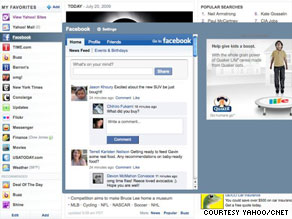
The revamp lets people select basic applications to use not just Yahoo sites, but also others' such as eBay, Facebook, and Twitter, said Tapan Bhat, Yahoo's senior vice president for consumer experiences.


These applications are available on the left side of the page under a customizable section called My Favorites; hovering over them with the mouse pointer makes each application and its accompanying advertising pop up.

"We're pulling together everything about the user they care about, be it on Yahoo or off, to create a personally relevant experience," Bhat said. "In a world like this, Yahoo needs to make the user experience come first."

The effort is a centerpiece of Yahoo's effort to revitalize its core business: showing content and accompanying advertisements to a large, general audience on the Net. Yahoo's profitability for years has trailed that of its main rival, Google, which depends chiefly on search ads for revenue, and Yahoo faces increasing pressure from Microsoft's online business and new arrivals such as Facebook as well.

The company also hopes for more success with advertisers. "We're creating great opportunities for advertisers to target content and context," he said, demonstrating a movie application that showed a prominent ad along with movie showtimes locally tailored for a particular user.
The My Favorites feature will arrive on Yahoo's search page, too, making the search site and results shown on it into more of a portal to access content. Yahoo faces search pressure from dominant Google and now to a certain extent from Microsoft's Bing, too.

Even if it consummates a possible search and advertising deal with Microsoft, being able to show its own display ads in applications adjacent to search results could help the company extract more money from its search operation.

Long-coming changes

Newer Web sites change rapidly, but Yahoo proceeds at a relatively glacial pace to change its site, visited by a whopping 340 million people monthly.

Yahoo announced the new front page plan in October 2007, recognizing that people wanted to get to other destinations on the Net besides Yahoo's. It began "bucket testing" it a year afterward, trying variations of the new page on randomly selected users, some of whom squawked at the changes and their inability to revert.

New Chief Executive Carol Bartz has been trying to light a fire under the company's developers, but even this revamp is only is the beginning beta testing on Tuesday.

The change will arrive in the U.K., France, and India later this week, in Spain and Mexico next month, and in Asia next year, Yahoo said.

Users had no choice about earlier tests, but now they'll be able to select it as default on their own by visiting http://yahoo.com/try new or clicking on Yahoo promotions for the change.

"The home page was tested by thousands and thousands of people. We got tons of feedback -- tens of thousands wrote about what they liked and didn't," Bhat said. "It was really key to helping us figure out what worked and didn't."

The new home page will become default for others when beta testing is done "in the coming months," Yahoo said. The revamped search pages will enter bucket testing in August, meaning that users can't choose to use or not use the new design.

More changes

Opening up Yahoo's content to other sites' operations -- and letting other sites use Yahoo data can use such as Facebook-like status updates -- is part of the Yahoo Open Strategy.

That effort, under way for well over a year, is designed to increase users' activity on Yahoo, to draw more people to Yahoo, and to make the company a better partner for advertisers.

There are about 60 applications available now, and more are being added daily, Bhat said. Users can create their own, too.

Also coming in August will be the ability to select what type of news people can see, with a slider that moves on a spectrum between "fun" and "serious," he said.

In addition, Yahoo is revamping its mobile site. One big feature: when users customize Yahoo for use with regular computers, that customization will carry over to their mobile version.

Bhat wouldn't share details about whether the new home page fares better, either in terms of user engagement or revenue. However, because Yahoo plans to make its official home page announcement Tuesday while detailing second-quarter financial results, it's possible Bartz may be more forthcoming than Bhat.

Bhat did indicate, though, that things are moving in the right direction for the company.

"Our experience in our test indicates that people are excited about this home page. They feel this meets their needs and is fresh new look for Yahoo," Bhat said. "We are designing the page around users. What we do know when design page that users like, they tend to get more engaged."

source : www.cnn.com


Wednesday, July 15, 2009

Google vs. Microsoft: What you need to know


In less than a week, Google announced an operating system to compete with Windows, while Microsoft announced that Office 10 will include free, online versions of its four most popular software programs -- a shot at Google's suite of web-based office applications.
And not more than a month and a half ago, Microsoft unveiled its new search engine Bing, which it hopes will steal market share from Google and finally make it real money online.

From the news of it, it's a full-blown tech battle, complete with behind-the-scenes machinations to sic government regulators on each other.


It is, however, not a death match -- it's more of an fight to see who will be the King of Technology, since both companies pull in their billions through completely different siphons and are unlikely to severely wound one another any time soon.

Google pulled in $22 billion in revenue in 2008, 97 percent of which came tiny text ads bought by the keyword and placed next to search results or on pages around the web. Google makes a negligible amount of money bundling its online apps for businesses, charging $50 a head annually -- but mostly it just gives its online text editor, email and spreadsheet programs away.

By contrast, Microsoft sold $14.3 billion worth of Microsoft Word and PowerPoint and other business applications over the last nine months, making a profit of $9.3 billion. It made a further $16 billion in revenue in 2008 through sales of its operating systems, which range from XP installations on netbooks, to Vista, to Windows Mobile to its server software.

Google now plans its own range of operating systems, starting with Android, an open-source OS for small devices like smartphones, and Chrome OS, a browser-focused, open-source OS that will run on notebooks and desktops.
Clearly top executives at each company look over at the others' pots of gold and dream of ways to steal them, or at least make it harder for the other guy to make money.

In fact, they even dislike each other enough to spend money to make the other one lose revenue -- take for example, Microsoft's behind-the-scenes campaign to scuttle last year's proposed Google-Yahoo advertising deal or its ongoing attempts to derail the Google Book Search settlement.

But in reality, the competition is really about creating universes or ecosystems that it hopes consumers will want to live their technology lives inside. And it's about ego -- a fight to be recognized as the world's most important technology company.

Microsoft would love for everyone in the world to be using its Internet Explorer browser to search through Bing to find a story from its MSN portal to email via Hotmail or Outlook to a friend. Add in a smartphone running Windows Mobile and an Xbox in the living room for the kids, and you have a Microsoft family. And though it is much joked about, Microsoft is the dominant platform for software developers of all types, whether they are making small business software, massive online role-playing games or photo-editing utilities.

Google's ecosystem looks different. It starts with a Google Chrome browser (oddly running only on Windows) with a default homepage set to Google News or a customized Google homepage. From there you might go to Gmail and then click on a Word document sent to you as an attachment which Google will quickly -- and safely -- open for you in its online word processor.

But most importantly, Google wants you to search and travel around the web, hitting web pages that run Google-served ads and Google tracking cookies. You might think that Google is a really cool company to give away all this free technology, while never thinking about the persistent and silent data collection Google is undertaking to profile you in order to deliver you to advertisers for a premium.

So how do the two stack up in four key areas of competition?

Browsers: Internet Explorer in all its variations still retains close to 70 percent of the market (depending on who is counting and how). That dominance remains, even though Microsoft's latest offering IE8 lags behind all the other major browsers in features and advanced web capabilities.

Firefox, Opera, and Apple's Safari have all driven browser innovation over the last five years, but most people have not been convinced to leave IE behind, despite other alternatives being safer and more advanced. Why does it matter? Well, IE installations come with a default home page, don't they?

Google's Chrome browser, on the other hand, is a handsome, whiz-kid of a browser. It's sleek and nimble, and it revolutionizes how tabs are handled. The address bar is the search box (Google as default, naturally). Each website opened runs as its own browser instance and has very low permissions to read and write to files. The sandboxing of tabs means that if a single website hangs or crashes, the rest are unaffected. Meanwhile, lower permissions make it harder for a hacker to bust into your computer through your browser.

Chrome also has less than 2 percent of the browser market share.

Online Search: Google's name now means search to most users. Google's search engine means money to Google. In June, it delivered 78.5 percent of search results pages delivered to U.S. web users. In the first three months of 2009, Google pulled in $5.2 billion in revenue, a majority of which came from AdWords, an auction-based service that triggers ads based on the keywords in a search query.

Microsoft recently debuted Bing, a new search engine it hoped would fare well in comparison to Google. It's got some fine innovations, and shows the company is thinking very hard about better ways to present information to users by finding ways to synthesize data, rather than just retrieving links. Still, despite these improvements, a $100 million ad campaign, and generous press coverage that treats Bing like an underdog, Bing gained only a point in June to get Microsoft 8.2 percent of all searches.

Operating Systems: Microsoft has been making operating systems since 1979 and has spent 28 years perfecting MS-DOS and Windows NT, the frameworks that Windows have been built around. Microsoft is estimated to run on about 90 percent of all laptops and desktops in the world. By copying its competitors' best features, leveraging questionable licensing arrangements and using its base of accustomed users to buy it time against innovators, Microsoft has held on to its lead in the OS market for almost 30 years. That's despite challenges from Digital Research, Apple and IBM.

Microsoft's newest version, Windows 7, will be available in the fall. Early reviews say the OS boots quickly and sleeps fast, and avoids much of the confusing interface decisions that have made many dislike Vista, the successor to Windows XP. Microsoft also dominates in the business world, where nearly every medium to large company standardizes around Microsoft Office. Microsoft is also at work on version 6 of its operating system for handheld devices, which it first launched in 2000.

Its OS advantages are immense. It has millions of users who know nothing else and who like Windows. There are millions who are attached to games or the thousands of desktop apps that are only available on Windows. Thousands of devices just plug in and work on its hardware. And familiarity with Microsoft software is a requirement for a huge number of office jobs.

By contrast, Google first stepped into the OS game in 2007 when it announced its Android operating system for small devices. Google estimates that some 18 phone models will be running its system by the end of the year. Last week, Google announced, but did not show off, a new OS to compete with Windows, dubbing it Chrome OS.

That name signifies that Google's OS will be for the web and browser-based. It hopes to convince developers to write software that runs inside a browser, instead of on top of the OS as developers for Windows and Apples' OS X do. It will also let web developers extend the power of their websites by expanding the capabilities of the browser, allowing websites to lean on the browser for storage and processing help.

Advertising: Google is largely powered by its innovative auction-based text ads on its own site, but then expanded into serving ads on other people's sites with the Adsense program. It bought the ad-serving and behavioral-profiling giant Doubleclick in 2007 for more than $3 billion, and has ventured into mobile, print, radio and television ads.

Microsoft has struggled to replicate Google's online advertising success. Despite owning MSN.com -- a portal that is second only to Yahoo as a destination -- Microsoft has not made money on the internet. To turbocharge its ad-delivery technology, it paid more than $6 billion in cash in 2007 for aQuantive, a full-service online advertising concern.

Instead, Microsoft's online ad business lost $1.2 billion in 2008, double what it lost in 2007. The company expects 2009 revenues to be higher than the $3.2 billion it took in last year, but has not said it would make a profit.

Contrary to what some might have you believe, the benefits of the Google-Microsoft competition are immense.

Microsoft had largely grown complacent until Google came along to shake up categories. Gmail's massive online storage capability and fancy programming made Microsoft hustle to upgrade its popular, though not user-friendly, web e-mail service. Google Maps led to Microsoft's Live Maps, which now bests Google's efforts in some ways.

Google has been winning the fight for the last few years, showing that it is still nimbler than the software giant from the Northwest. But the pendulum may be slowing, or even poised to swing the other way. With the innovations in Bing and the promise that Microsoft's online Office offerings will be free and more fully featured than the Google equivalent, Microsoft is taking on Google where it matters for users: on the field of innovation.

Source : www.cnn.com